
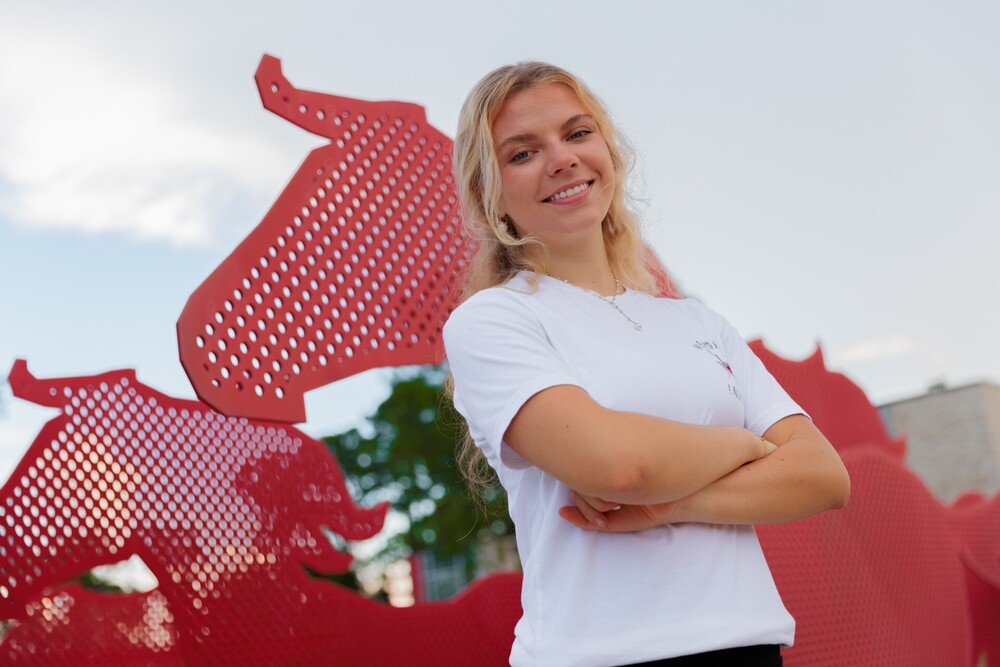
Memorial High School (MHS) rising senior Anfisa Bogdanova created FUSE to connect students with opportunities, mentorship and peer support, helping them turn their interests into meaningful, published work.
What happens when students don't wait for someone else to create an opportunity?
They create it for each other.
That's the idea behind FUSE, a student-led initiative founded by Memorial High School rising senior Anfisa Bogdanova. FUSE helps high school students discover research, mentorship and academic opportunities while providing the structure and peer support to turn their own interests into meaningful projects.
Through FUSE's Impact Scholars program, students choose a topic they care about, conduct research, develop a paper or article, receive feedback and ultimately publish their work.
For Bogdanova, the goal goes beyond completing a project. It's about students helping other students recognize what's possible and giving them the confidence to begin.
"I wanted students to have someone who would take their ideas seriously and help them turn those ideas into something complete and tangible," Bogdanova said.
Creating the Opportunity She Wanted Others to Have
The idea for FUSE grew from Bogdanova's own experience searching for research experiences, internships, mentorship and academic programs.
The summer before her junior year, she created a science blog and completed an internship at Rice University. Those experiences strengthened her research and writing skills, but they also changed the way she viewed her own potential.
She began to recognize another challenge: Students can miss meaningful opportunities simply because they don't know they exist or aren't sure how to get started.
"I noticed that many qualified students missed out on research, mentorship and academic opportunities simply because they didn't know they existed or didn't know where to begin," Bogdanova said. So, she created a way to help.
Bogdanova developed FUSE's program structure and resources, created research and blog pathways, met individually with students, reviewed drafts, provided feedback and helped participants move from an initial idea to finished work.
The result is student-to-student collaboration that crosses schools, interests and disciplines.
Memorial High School student Mark Chebli researched how tire pressure and temperature affect tire efficiency, connecting his interest in engineering with the real-world challenge of reducing fuel costs. He said FUSE's structure and accountability helped him complete his first formal research paper and reinforced his interest in pursuing engineering.
Fellow Memorial student Francesca Belopolsky explored topics ranging from dreams and artificial intelligence to business and Mars. She said mentorship, deadlines and feedback helped her organize her ideas, strengthen her writing and learn how to use feedback to improve her work.
"Seeing my work actually published felt exciting and rewarding," Belopolsky said. "It felt good to share my ideas and thoughts with others."
Bailey Yu, a senior at Lamar High School, investigated the role of artificial intelligence in investment decision-making. She said the experience helped her narrow a broad interest into a focused research question and strengthened her confidence as a researcher and writer.
"Because of FUSE, I now know I can turn my curiosity into meaningful research," Yu said.
Gustavo Rivas, a senior at Strake Jesuit College Preparatory, explored gravitational microlensing and exoplanet discovery, tackling concepts beyond those typically encountered in a high school physics classroom.
His advice to other students captures the spirit of FUSE: "Start before they feel qualified."
Students Leading and Learning Together
For Bogdanova, seeing those projects develop has reinforced why student-to-student support matters.
"Some students initially spoke about their ideas as though they were not important enough to pursue," she said. "Once they were given encouragement, accountability and a clear next step, they became much more independent and ambitious."
The finished publications are important, but so is what happens along the way. Students learn to ask questions, organize complex ideas, respond to feedback, work through challenges and take greater ownership of their learning.
Bogdanova has learned alongside them.
"Leadership is much less about being the person at the front and much more about creating the conditions in which other people can succeed," she said.
She hopes to continue building FUSE into a sustainable student-to-student network with additional mentors, stronger systems for feedback and more opportunities for students to present and discuss their work. Her long-term vision includes Impact Scholars eventually returning to mentor the students who follow them.
It's a model built on students creating opportunities for one another and recognizing that they don't have to wait until college or a future career to begin exploring big ideas.
"I created FUSE because I believe students can turn curiosity into meaningful work when someone gives them the opportunity, structure and confidence to begin," Bogdanova said.
For the students participating in FUSE, that first step is already leading somewhere.